
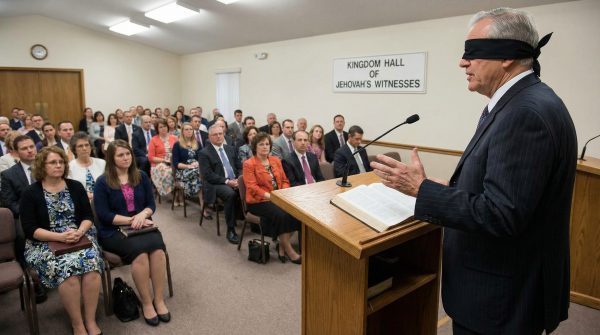
“Who is blind as the one rewarded, or blind as the servant of Jehovah?”
– Isaiah 42:19
CHAPTER MENU
Related articles, videos

The Watchtower Idol

His watchmen are blind.

Blind Yourselves and be blinded
Share this chapter
SIDE NOTES
Speaking of his second coming, Jesus referred to both the days of Noah and Lot. However, Christ did not mention the rampant wickedness that prevailed in the days of Noah due to the presence of wicked angels and their Nephilim offspring. Instead, the Lord merely said people were eating and drinking and marrying and took no note.
Likewise, Jesus made no reference to the gross sexual perversion of the Sodomites but merely noted men were buying and selling, building and planting until the day fire and sulphur fell from the skies. The reason Jesus did not emphasize the prevailing wickedness in both examples is that the warning is directed at Christians who are busily engaged in eating and drinking, marrying, buying and selling, and planting and building.
Jesus made the lesson clear when he went on to say: “It will be the same on that day when the Son of man is revealed. On that day, let the person who is on the housetop but whose belongings are in the house not come down to pick these up, and likewise, the person out in the field must not return to the things behind. Remember the wife of Lot. Whoever seeks to keep his life safe will lose it, but whoever loses it will preserve it alive. I tell you, in that night two people will be in one bed; the one will be taken along, but the other will be abandoned. There will be two women grinding at the same mill; the one will be taken along, but the other will be abandoned.” – Luke 17:30-35
The fact that Jehovah’s Witnesses are blind and deaf to the significance of the parousia and have no expectation of the revealing of Christ is reason enough to expect many are taking no note, and that more than a few will be abandoned on the day the Son of man is revealed.
Just imagine the wonderful privilege that the apostles had of personally associating with Jesus on a daily basis, traveling with him, being with him on social occasions, and listening to him masterfully silence the Pharisees and other critics. What an honor to be able to ask Jesus any question that they might have on their mind, and he would answer!
When Jesus gave the most inspiring sermon ever given—the Sermon on the Mount—they were there.
They were on the Sea of Galilee when Jesus roused himself from sleep in the storm-tossed little fishing boat, and when he, with a mere word, instantly calmed the tempestuous wind and waves! When Jesus’ very word would make the demons shiver in fright, open the ears of the deaf, give sight to the blind, calm a tempestuous sea, and even wake the dead from their slumber, the apostles were at his side. They were eyewitnesses to so many amazing things that Christ said and did that John later wrote, “I suppose that all the books in the world could not contain the detailed account of the life and ministry of Jesus Christ!”
However, despite having Jesus as their personal tutor, the modern reader of the gospel accounts cannot help but be struck by how unenlightened the apostles seemed at times. While they had the privilege of speaking directly with Jesus, he also frequently rebuked them. Take, for example, the fact that Jesus plainly spoke to the apostles on numerous occasions about his impending death and resurrection, yet they could not grasp what he was telling them.
In the 16th chapter of Matthew, Jesus asked the apostles who they thought he was. Peter responded positively, saying that Jesus was the Son of the living God, to which Jesus acknowledged that his Father was responsible for revealing it to them. But shortly after that, the account says: “From that time forward, Jesus began explaining to his disciples that he must go to Jerusalem and suffer many things from the elders and chief priests and scribes and be killed, and on the third day be raised up. At this Peter took him aside and began to rebuke him, saying: ‘Be kind to yourself, Lord; you will not have this happen to you at all.”’
What a humiliation for Peter to presume to counsel Jesus Christ in this matter, as if Jesus did not know what he was talking about when he spoke of his impending death, especially since Christians now recognize that the death and resurrection of Jesus is the very cornerstone of the Christian faith. So the question has to be asked: How could the apostles have been so blind to the truth? The question is not merely an academic exercise. The answer is most relevant to the situation in which Jehovah’s Witnesses find themselves today.
The reason the apostles could not comprehend what Jesus was teaching when he spoke so plainly of his death and resurrection is that it was not Jehovah’s will for them to understand at that time. Consider what Luke 9:44-45 states in this regard: Jesus said to them: “‘Listen carefully and remember these words, for the Son of man is going to be betrayed into men’s hands.’ But they did not understand what he was saying. In fact, it was concealed from them so that they might not grasp it, and they were afraid to question him about this saying.”
In view of that statement, two very important questions arise: First, why couldn’t the apostles understand something that seems so elementary and straightforward to Christians today? Secondly, why did God apparently conceal this simple truth from the apostles, when Jesus had previously said that his Father had revealed to them that he was the Christ? What purpose was served by their enforced ignorance?
No doubt, the primary reason the apostles could not grasp Jesus’ teaching about his death was that they held preconceived ideas based on their limited knowledge of the prophecies concerning the Messiah. They imagined that Jesus would literally sit on David’s throne in Jerusalem. That misunderstanding made it impossible for them to comprehend the greater spiritual reality; namely, that the heir to the throne of David would reign from a heavenly Jerusalem rather than from any literal city on earth.
All that the apostles knew and believed was that Jesus was the heir and rightful king, the Son of God, which, admittedly, was certainly more than the Jewish establishment was willing to accept. But, since the Hebrew prophecies foretold that the messianic descendant of David was going to reign forever over all nations, the talk of Jesus’ death did not make any sense to them at the time. So, it was their own erroneous ideas and lack of vision that prevented them from understanding that Jesus had to die.
However, after Jesus was resurrected, he fully opened up their minds, even as Luke 24:27 says: “And commencing at Moses and all the Prophets he interpreted to them things pertaining to himself in all the Scriptures.”
But the question remains as to why Jehovah did not see fit to lift the veil of ignorance that shrouded the apostles before Jesus’ death and resurrection.
Besides their preconceived notions, another reason was the apostles’ own lack of faith. That is why in the preceding verse, Jesus rebuked them again, saying: “O senseless ones and slow in heart to believe on all the things the prophets spoke! Was it not necessary for the Christ to suffer these things and to enter into his glory?”
Matthew 28:17 reveals that some of the apostles doubted, even in the very presence of their resurrected Lord! It should serve as a humbling lesson to all Christians that Jesus described his closest disciples—the very foundation stones of his congregation—as “senseless and slow in heart to believe on all the things the prophets spoke.”
Another reason the apostles had to have their faith tested is that Satan demanded that such a test be made of those whom Jehovah had chosen to rule the universe with Christ. That is why Jesus explained to Peter on the night of his betrayal and arrest that Satan had especially demanded to have the apostles, to sift them as wheat. Jesus, though, reassured Peter that he had supplicated Jehovah on their behalf so that their faith might not give out under test.
Peter could therefore speak from experience when he later wrote about Christians “being grieved by various trials, in order that the tested quality of your faith may be found a cause for praise and glory and honor at the revelation of Jesus Christ.”
Satan’s demand appears to be the primary reason Jehovah concealed the reality of the death of Christ from the otherwise enlightened apostles. And what a test it was! When faced with the accusation of having been associated with Jesus, Peter denied even knowing the man three times.
Without question, with the establishment of Christianity, the quality of each Christian’s faith and the depth of devotion to God became the focus of the Devil’s accusations. Before the universal issue is settled with finality, every servant of God must face some sort of trial that can only be surmounted by faith. God is pleased to allow his servants to prove their faith under trial in order to silence the Accuser.
Now, the question to be considered here is this: If Jehovah saw fit to allow so severe a test of faith to befall the original followers of Christ, why should anyone suppose that Christians living at the tumultuous time of Christ’s return will somehow be exempt from such tests?
“HE HAS COVERED YOUR HEADS, THE VISIONARIES”
Just as certain vital truths were concealed from the apostles, the prophecies reveal that it also serves the divine purpose to allow a similar “operation of error” to complete its work among true Christians. In this regard, Jehovah has determined that his own people shall be stupefied as with intoxicating liquor, so as to be blind to the very outworking of his grand purpose in connection with them. Isaiah 29:9-10 reads: “Linger, you men, and be amazed; blind yourselves, and be blinded. They have become intoxicated, but not with wine; they have moved unsteadily, but not because of intoxicating liquor. For upon you men Jehovah has poured a spirit of deep sleep; and he closes your eyes, the prophets, and he has covered even your heads, the visionaries.”
Although intoxicated with their own knowledge and supposed importance as God’s appointed spokesmen, from Jehovah’s standpoint, the leading men of Ariel are as unreasoning as an inebriate. And it should be noted that the scripture does not say that God closes the eyes of those who merely claim to be his prophets and visionaries. Nor does it say that they are necessarily false prophets and valueless visionaries, although elsewhere in prophecy they are described as such. After all, though, the apostles served as spokesmen and prophets when they were first commissioned by Jesus to announce that the Kingdom of God had drawn near; nevertheless, Jehovah was pleased to temporarily conceal from them the vital truth as regards Jesus’ sacrificial death.
Reasonably, then, God also recognizes the “prophets” and “visionaries” of Isaiah’s prophecy as his servants; but following the pattern that was established in connection with the pre-Pentecost apostles and disciples, Jehovah has likewise concealed the meaning of the recorded prophetic visions from his otherwise enlightened servants, until such time as he is pleased to unveil the truth to those with faith.
The context of the prophecy in the 29th chapter of Isaiah concerns Jehovah making things difficult for his servant Ariel, allowing him to suffer mourning and lamentation before finally redeeming him from calamity. The reason that God allows such a judgment is stated in the 13th verse, which reads: “This people approaches me with their mouth and they honor me with their lips, but their heart is far removed from me; and their fear of me is based on commands of men that they have been taught.”
Only God can read the secrets of the human heart, and only he is in a position to determine if our hearts are complete towards him. It matters not how we may judge ourselves; it is God’s judgment that counts. That is why Paul stated in 1 Corinthians 4:4: “For I am not conscious of anything against myself. Yet by this I am not proved righteous, but he that examines me is Jehovah.”
As an example of Jehovah’s penetrating foresight and insight, Jesus quoted the prophecy of Isaiah and applied it to the Jews when he said: “You hypocrites, Isaiah aptly prophesied about you, when he said, ‘This people honors me with their lips, yet their heart is far removed from me.’”
The Jews had corrupted God’s law by turning it into mere human tradition. But the point is that the Jews were God’s people at the time—they were his servants. Yet the context indicates that the prophecy primarily applies to the Christian Israel, as Jesus only applied the principle to the Jews of his day.
In reality, the judgment applies most aptly to Jehovah’s Witnesses today. How so? Well, who else glorifies Jehovah with their mouths? The clerics and parishioners of Christendom certainly have not honored the name of Jehovah. Far from it! They rarely make mention of God by his personal name. Translators of the Bible have even gone so far as to expunge the sacred name of God from their versions of the Bible—substituting God’s unique personal name with generic terms like Lord and God. They have dishonored Jehovah with their nonsensical Trinity and other pagan religious doctrines and practices.
On the other hand, Jehovah’s Witnesses glorify Jehovah “with their lips” by speaking about God in an organized public ministry and within the congregations. Be that as it may, from God’s lofty vantage point, he evidently discerns that the fear of him has degenerated into following mere human commandments. Indeed, who can deny that Jehovah’s Witnesses place great emphasis on closely adhering to organizational procedures and policies emanating from the Watchtower?
Unquestionably, the Watchtower is the very heart and soul of the faith of Jehovah’s Witnesses. Equally undeniable is that Jehovah’s Witnesses are more the agents and representatives of the Watchtower Society and far less so the actual ministers of Jehovah. Jehovah’s Witnesses are not only instructed as to what to say in the ministry, but how to say it as well. Bethel determines virtually every aspect of faith to such an extent that it is not at all unusual to hear Jehovah’s Witnesses cite the authority of ‘The Society,’ as opposed to the authority of the Bible or Jehovah God himself.
With no hint of irony, the Society has even instructed Jehovah’s Witnesses not to say ‘the Society says…’ It is no wonder that outsiders and ex-Jehovah’s Witnesses alike view Jehovah’s Witnesses as the victims of a brainwashed cult.
Paul indeed counseled Christians to be obedient to those taking the lead among them. Still, the apostle was also aware of the prevailing tendency among Christians to become mere followers of men. Some of the Corinthians had even declared themselves to belong to Paul, others to Peter, and Apollos.
Are Christians today any less inclined to follow men or an organization? Clearly, the answer is no. That being the case, and in view of the all-imposing role that the Organization plays in the lives of Jehovah’s Witnesses, the question is whether Jehovah’s Witnesses are actually devoted to Jehovah God and are really following in the footsteps of Christ, or are they mere followers of men?
What is to be the end for those who merely honor Jehovah with their lips but whose hearts are far removed from him? That is what the remainder of the 29th chapter of Isaiah is about. The 14th verse states that God “will act wonderfully again with this people, in a wonderful manner and with something wonderful; and the wisdom of their wise men must perish, and the very understanding of their discreet men will conceal itself.”
If the judgment of Isaiah applies to Christendom, how is it that God is to “act wonderfully again with this people”? It should be considered a good thing if God acts toward someone in a “wonderful manner.” Since the entire context of Isaiah outlines how Jehovah will bring about a restoration of heart for his people, it must be concluded that “their discreet men,” those whose wisdom “must perish” in the face of God’s judgment, is none other than the faithful and discreet slave.
In spite of the collective wisdom and knowledge of the Watchtower Society, when it comes to understanding the judgments of Jehovah contained in prophecy, the Society’s discreet men and organizational seers may as well be illiterate. There is no greater testament to their interpretational illiteracy and blindness than what is contained in the Watchtower’s own commentary of Isaiah.
Although Bethel would never admit to being blind or ignorant, it is apparent that the following portion of prophecy most aptly fits them: “Every vision becomes for you like the words of a sealed book. When they give it to someone who can read, saying: ‘Read this out loud, please,’ he will say: ‘I cannot, for it is sealed up.’ And when they give the book to someone who cannot read, saying: ‘Read this, please,’ he will say: ‘I cannot read at all.’
Just as the apostles’ assumptions stumbled them, so too, the Watchtower’s cocksureness that Christ began ruling the world in 1914 virtually insures that Jehovah’s Witnesses will be confronted with a severe test of faith when Christ actually arrives. And precisely at that critical moment, the prophecies indicate that Jehovah’s earthly mouthpiece will be silenced. Isaiah 29:4 foretells: “You will be brought low; from the ground you will speak, and what you say will be muffled by dust. Your voice will come from the ground like the voice of a spirit medium, and your words will chirp from the dust.”
Jehovah cryptically describes his organizational servant, Ariel, as being brought low, so that his voice becomes ghostlike—as if arising from the dust in a faint whisper from beyond the grave. By such imagery, God is foretelling that the once robust voice of his Christian servant will become muted during the judgment. Since Jehovah’s Witnesses have come to accept that the Watchtower is the earthly mouthpiece of Jehovah’s organization, Ariel’s chirping from the dust means that Christ’s faithful and discreet slave will become speechless, as if afflicted with aphasia. Worse, by likening the muffled voice of Ariel to “a spirit medium,” it harmonizes with what is stated in Amos: ‘and as regards Bethel, it will become something uncanny.” (5:5)
Only then will God open the eyes of the blind and unstop the ears of the spiritually deaf—not by means of any earthly agency, but directly by means of Christ Jesus, as foretold at Isaiah 29:18: “In that day the deaf will hear the words of the book, and out of the gloom and darkness the eyes of the blind will see. The meek will rejoice greatly in Jehovah…”
If the meek ones are to “increase their rejoicing in Jehovah himself,” of necessity, that means that the meek have rejoiced in Jehovah prior to their having their eyes and ears opened— just not to the fullest extent.
The 29th chapter of Isaiah concludes with Jehovah accomplishing his purpose with his erring people by personally instructing them, and finishing their training. And just as the apostles finally had their blinded eyes pried open after Christ’s resurrection, in the same way “Jacob” is reassured that his children, the other sheep, will finally come to know God and fully understand the truth: “For when he sees his children, who are the work of my hands, in his midst, they will sanctify my name; Yes, they will sanctify the Holy One of Jacob, and they will stand in awe of the God of Israel. Those who are wayward in spirit will acquire understanding, and those who complain will accept instruction.”
“MY OWN IDOL HAS DONE THEM”
The 48th chapter of Isaiah similarly explains that Jehovah has concealed a considerable body of scriptural truth from his people, keeping it secret until a future time of revelation. Isaiah 48:6-7 speaks from a future point in time, as if from a time capsule, saying: “You have heard and seen all of this. Will you not declare it? From now on I am announcing new things to you, guarded secrets that you have not known. Only now are they being created, and not long ago, things that you never heard before today, so that you cannot say, ‘Look! I already know them.’”
What purpose is served by Jehovah keeping secrets from his servants? The fifth verse explains that it is in order “that you might not say, ‘My own idol has done them, and my own carved image and my own molten image have commanded them.’” That Jehovah withholds light from his people in order to discredit the Watchtower idol is evident from the 11th verse, which goes on to say: “For my own sake, for my own sake I will act, for how could I let myself be profaned? I give my glory to no one else.”
Because the Watchtower immodestly takes credit for revealing all truth, God has seen fit to withhold vital revelations in order to discredit the all-knowing, all-seeing idol. During the period of distress and affliction, Jehovah then becomes King by repurchasing his humiliated servants and revealing his “guarded secrets” directly to them.
Now for the questions posed in the title and caption of this chapter, taken from Isaiah 42:19, which reads: “Who is blind except my servant, so deaf as the messenger I send? Who is so blind as the one rewarded, so blind as the servant of Jehovah?”
What is the answer?
Well, to whom is God speaking in the 20th verse, which says: “You see many things, but you do not keep watch. You open your ears, but you do not listen.”
Jehovah’s Witnesses certainly give evidence of having had the privilege of seeing many things—even many deep and hidden things in God’s Word.
And Jehovah’s Witnesses boast of being “in the truth” and of having their ears opened to hear the truth. But, just as God holds things in reserve in order that his people may not continue to brag that their idol has already revealed it to them, the verse preceding God’s series of questions at Isaiah 42:18-20 also reveals that the underlying reason for the blindness of his servants is that they are idolaters. The 17th verse reads: “They will be turned back and will be utterly put to shame, those who trust in carved images, those who say to metal statues: ‘You are our gods.’”
God’s purpose is to cause his people to “be turned back” from their organizational idolatry so as to worship and trust God exclusively.
Jehovah’s Witnesses will surely object to having any other god but Jehovah, but the truth is the man of lawlessness “exalts himself above every so-called god or object of worship, so that he sits down in the temple of God, publicly showing himself to be a god.”
This man of lawlessness is superior to the lying clergymen. He presides over spiritual paradise. He knows the truth about the soul and Hell. He teaches the pure language of truth and speaks sacred secrets in the name of Jehovah. This man of lawlessness is the spiritual leader of Christ’s congregation until the manifestation of Jesus’ presence brings him to nothing.
Now, as regards the answer to the searching rhetorical questions God will pose in the future, as to who is blind except the servant of Jehovah, when Jehovah himself becomes King, the only answer that a humble servant can possibly offer to God in reply is: ‘No one, Father. No one is as deaf as your own messengers. No one is as blind as your servant. None is as blind as Jehovah’s Witnesses!’
The Bible is so much more than an account of God’s past doings. It establishes a pattern of things to come —a revelation of the future, even the words of God yet to be spoken; the culmination of which is yet to transpire during the unveiling of Jesus Christ.