
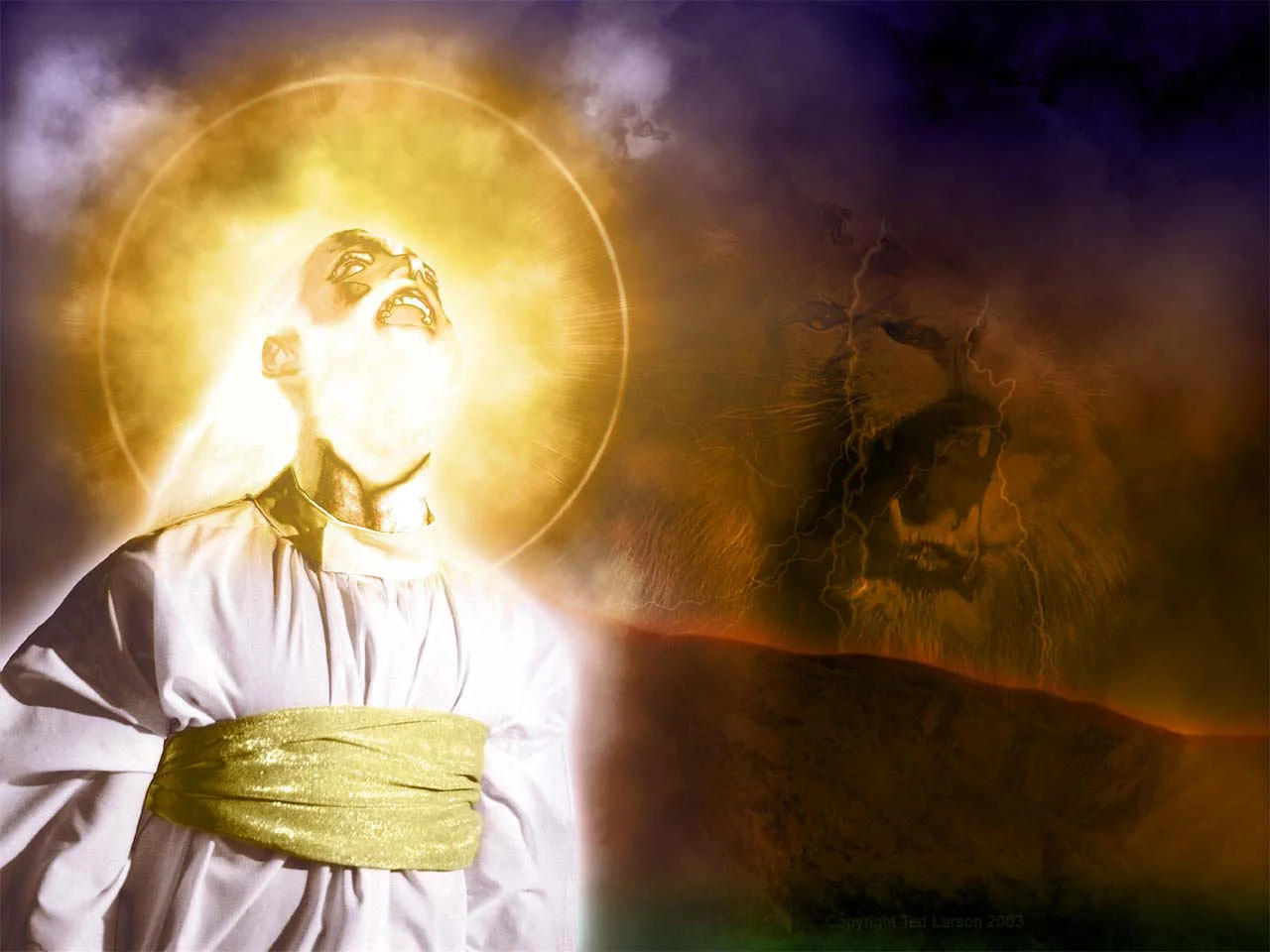
“The great day of Jehovah is near! It is near and it is approaching very quickly! The sound of the day of Jehovah is bitter. There a warrior cries out.”
-Zephaniah 1:14

Chapters Index
Related videos and articles

O nation that feels no shame

The unrighteous one knows no shame
Jehovah is righteous in her midst
Share this chapter
SIDE NOTES
The prophecy of Zephaniah, though set in ancient times, outlines the execution of Jehovah’s judgment against false worshipers at the time of Christ’s return. Special attention will be given to those whom Jude said were shepherds who lurked like submerged rocks below water, feasting with unsuspecting Christians.
At Zephaniah 1:12, Jehovah describes it this way: “At that time I will carefully search Jerusalem with lamps, and I will call to account the complacent ones, who say in their heart, ‘Jehovah will not do good, and he will not do bad.'”
The fact that complacent ones only voice their opinion in their hearts ought to remind us of what Jesus said to the symbolic congregation in Thyatira: “And I will kill her children with deadly plague, so that all the congregations will know that I am the one who searches the innermost thoughts and hearts, and I will give to you individually according to your deeds.”
Jehovah is well aware of the presence of the secretive Masonic cult within the Watchtower. These words are addressed to them: “And I will wipe out from this place every vestige of Baal, the name of the foreign-god priests along with the priests, and those who bow down on the rooftops to the army of the heavens, and those who bow down and pledge loyalty to Jehovah while pledging loyalty to Malcam; And those who turn away from following Jehovah and who do not seek Jehovah or inquire of him.” – 1:4-6
The expressions “the day of Jehovah” and “the day of Jehovah’s anger” were used by the prophets Isaiah, Ezekiel, Joel, Obadiah, Amos, and Malachi. Those terms appear seven times in the brief prophecy of Zephaniah alone. Through Zephaniah, Jehovah expresses his determination to annihilate faithless evildoers and false worshippers from among his people, particularly their occultic priests of Baal. The prophecy also denounces the surrounding nations—including Assyria.
As with other prophecies, though, it is evident that God intended the prophecy of Zephaniah to apply far beyond the affairs of Judah and the ancient world. For example, Zephaniah 1:18 indicates that Jehovah’s denunciation is global—total. That verse reads: “Neither their silver nor their gold will be able to save them in the day of Jehovah’s fury; for by the fire of his zeal the whole earth will be consumed, because he will make an extermination, indeed a terrible one, of all the inhabitants of the earth.”
But in keeping with the established principle that judgment begins with the house of God, Zephaniah 1:4-6 relates the central feature of the day of Jehovah: “I will stretch out my hand against Judah and against all the inhabitants of Jerusalem, and I will wipe out from this place every vestige of Baal, the name of the foreign-god priests along with the priests, and those who bow down on the rooftops to the army of the heavens, and those who bow down and pledge loyalty to Jehovah while pledging loyalty to Malcam; and those who turn away from following Jehovah and who do not seek Jehovah or inquire of him.”
As has been pointed out already, and as Jehovah’s Witnesses are well aware, the city of Jerusalem was not only the capital of the Judean kingdom, it was also the exclusive center for the worship of Jehovah God; Solomon’s temple being located on the highest outcropping of the mound upon which Jerusalem was situated. Because the sacred name of Jehovah was intimately associated with Jerusalem and its temple, Jehovah was moved by zeal for his own name to punish those who disrespected and reproached his name by worshiping false gods.
True to his word through Zephaniah, the destruction Jehovah brought upon the city by the Babylonians finished off —once and for all —the degraded worship of Baal and Malcam. Never again would Jehovah tolerate in his rebuilt temple the likes of the disgusting Canaanite god, Baal, or Malcam (Molech)—“the disgusting thing of the Ammonites.”
As for any modern application, the Watchtower assumes that Christendom is the antitype of unfaithful Jerusalem. However, how is it that the clergy and parishioners of Christendom could be guilty of pledging loyalty to both Jehovah and Malcam? Since Christendom has never embraced the name or person of Jehovah, preferring instead to worship the Christianized version of the mythical, Babylonian Trinity—those who are condemned for turning away from following Jehovah (apostatizing) must be those Christians who at one time actually worshipped and followed Jehovah—such as Jehovah’s Witnesses.
But, if that is true, how could any Christian witness of Jehovah possibly pay homage to the now non-existent idols representing Baal or Molech? In this regard, the February 15, 2001, Watchtower published a series of study articles on Zephaniah. In the article titled Jehovah’s Day of Judgment is Near, the Watchtower states:
“The worship of Molech included child sacrifice…All of this may well remind us of Christendom, steeped in false worship and astrology. And her role in the sacrificing of millions of lives on the altar of clergy-supported warfare is disgusting indeed!”
Likening the devilish practice of child sacrifice to Christendom’s participation in the bloodletting of war is not really an apt comparison since the Israelites fought wars that were sanctioned by God—often against the very worshippers of Baal and Molech and other heathen deities. And at times, Jehovah even sanctioned the execution of women and children as those devoted to destruction. Besides, soldiers of war are hardly comparable to the helpless babes who were cruelly sacrificed on the altar to the bloodthirsty god, Molech.
A more apt comparison to the demonic ritual of child sacrifice is the pedophilia practiced by some of the clergy of Christendom, particularly Catholic priests. Although victims of pedophilia are not literally sacrificed to the demons, as were the poor unfortunates of the past, it is as though their childhood innocence is. Considering that the demons were originally righteous angels that forsook their proper dwelling place in heaven in order to have sexual relations with creatures of another sort, the unnatural sexual act between an adult and a child mimics those demonic perversions of a greater dominating a lesser.
Surely the satanic spirit that once promoted the sacrifice of innocent children to Molech is the same evil influence behind the scourge of pedophilia in modern times. The damage done to the innocent victim of sexual abuse is, in some ways, more heartrending and certainly longer lasting than had they actually been killed and offered up to the flames of Molech’s altar.
Many victims of child sexual abuse suffer a lifetime of emotional and psychological problems. Some victims even commit suicide after enduring years of mental anguish. In that respect, the end result is the same as if they had actually been devoted to the fire.
But while the churches of Christendom have certainly had their child abuse scandals, the Watchtower organization has also been seduced into tolerating the sacrifice of the sexual innocence and purity of young children to the demons. Likely, many of Jehovah’s Witnesses will be offended by such a statement, but first consider God’s view.
The Israelites were introduced to the worship of Baal even before they entered into the Promised Land. This came about on the Plains of Moab by the cunning of Balaam, who counseled King Balak to use Moabite women as prostitutes to seduce the Israelite men into sexual immorality and idolatry. Tragically, it worked. The historical account in Numbers 25:1-3 says: “Then the people started to have immoral relations with the daughters of Moab. And the women came calling the people to the sacrifices of their gods, and the people began to eat and to bow down to their gods. So Israel attached itself to the Baal of Peor; and the anger of Jehovah began to blaze against Israel.”
“HOLDING FAST THE TEACHING OF BALAAM”
True, there is no mention of child sacrifice on that particular occasion; however, the significance of Israel’s fall into the worship of Baal is found in the book of Revelation. Jesus’ inspired letter to the congregation of anointed Christians in Pergamum reveals that Balaam has a spiritual counterpart alive and well within Christ’s congregation on the Lord’s day. At Revelation 2:14, the Lord Jesus speaks to the congregation, saying: “Nevertheless, I have a few things against you, that you have there those adhering to the teaching of Balaam, who taught Balak to put a stumbling block before the sons of Israel, to eat things sacrificed to idols and to commit sexual immorality.”
The historical Balaam was no ordinary man. He was a great man. On several occasions, he conversed with Jehovah God himself! For example, we read: “Then God came to Balaam and said: ‘Who are these men with you?’ So Balaam said to the true God…” (Numbers 22:9-10) And again in the 22nd verse: “Then God came to Balaam by night and said to him…” And again at Numbers 23:16: “Subsequently Jehovah got in touch with Balaam and put a word in his mouth…”
Balaam was even blessed with God’s holy spirit at one point, as it says at Numbers 24:2-3: “When Balaam raised his eyes and saw Israel tabernacling by his tribes, then the spirit of God came to be upon him.” Balaam was also inspired to say of himself: “The utterance of the one hearing the sayings of God, and the one knowing the knowledge of the Most High— A vision of the Almighty he got to see while falling down with the eyes uncovered…”
The point is, Balaam knew Jehovah. At least he knew that Jehovah would not tolerate Baal worship among his people. So after failing to curse the Israelites, greedy for the reward money, Balaam cunningly counseled Balak to induce God’s people into unfaithfulness, knowing that Jehovah would become offended. However, the teaching of Balaam was not particularly intended to lure every single Israelite male into fornication. That was not necessary to provoke Jehovah into venting his wrath upon the nation. In his cunning, Balaam apparently knew that Jehovah’s anger could be kindled if even a relatively small number of Israelite men actually engaged in the Bacchanalia—just as long as the leadership passively tolerated the sin. That is evident by the fact that the scourge upon Israel was halted only after a priest named Phinehas took action and executed two fornicators in the camp.
Just as Jesus spoke of those in the Pergamum congregation who were “holding fast the teaching of Balaam,” the Christian writers, Peter and Jude, also warned believers to be on guard against those false teachers who “have rushed into the erroneous course of Balaam for reward.” Such men lurk like “rocks hidden below water”—their treachery concealed from the unsuspecting. The reason they pose such a spiritual danger to Christians is that these Balaam-like agents are trusted elders and leaders who feast together with God’s people. That is apparent by Jude’s further comments, which identify them as “shepherds who feed themselves without fear; waterless clouds carried here and there by the wind; fruitless trees in late autumn, having died twice and having been uprooted; wild waves of the sea that cast up the foam of their own shame; stars with no set course, for which the blackest darkness stands reserved forever”
“Shepherds who feed themselves” are obviously self-serving elders in the congregation, perhaps even posing as one among the anointed faithful slaves. Their being likened to “stars with no set course” would seem to suggest that they pose as spiritual guides, but their “guidance” is as unreliable as navigating by following a wandering star in the sky.
Just as Jesus asked the Pharisees how they thought they were going to escape the judgment of Gehenna, the odd description of their “having died twice” must mean that their course of treachery has already brought upon them the judgment of the second death.
Since that very judgment is also reserved for the evil slaves of Christ’s illustrations, “the teachings of Balaam” must ultimately emanate from them.
“YOU TOLERATE THAT WOMAN JEZEBEL”
Another notorious Baal worshiper was Queen Jezebel. And Jesus, too, mentions her, as being an evil influence in the congregation during the Lord’s day. At Revelation 2:20, the Lord Jesus addresses his congregation, saying: “Nevertheless, I do hold this against you, that you tolerate that woman Jezebel, who calls herself a prophetess, and she teaches and misleads my slaves to commit sexual immorality and to eat things sacrificed to idols.”
In commenting on the meaning of the verse, the Watchtower freely admits that every year tens of thousands of Jehovah’s Witnesses are expelled from the congregations for practicing various forms of sexual immorality. That, though, is in keeping with what Paul advised congregations to do to unrepentant fornicators in their midst. So, it is not likely that Jesus would condemn his disciples for tolerating that particular aspect of immorality. Be that as it may, what about the way child-abusing pedophiles have been dealt with? Can the Watchtower boast of having purged wicked pedophiles from the organization with the same zeal as it has disfellowshipped tens of thousands of young adults and teenage fornicators?
Jesus went on to say of Jezebel: “And I gave her time to repent, but she is not willing to repent of her sexual immorality. Look! I am about to throw her into a sickbed, and those committing adultery with her into great tribulation, unless they repent of her deeds. And I will kill her children with deadly plague, so that all the congregations will know that I am the one who searches the innermost thoughts and hearts, and I will give to you individually according to your deeds.”
Take note of the fact that Jesus puts up with “Jezebel” and her lovers all the way up until throwing her and her children “into great tribulation”; obviously, during the great tribulation. It is apparent, then, that an immoral Jezebelian influence exists in the congregation up until the very moment when Christ removes it—permanently. The point is, though, Jesus does not merely punish the fornicators themselves. Christ rebukes those who “tolerate that woman Jezebel” and the teachings of Balaam. Because both Balaam and Jezebel factions within the congregations promote some form of idolatry among the true disciples of Christ, evidently with some measure of success, could it be that the sort of idolatry they promote is the idolatry of the Watchtower organization itself? Consider a few relevant facts.
It is an undeniable fact that in both subtle and not-so-subtle ways the Watchtower’s policies have muzzled the victims of pedophilia and their families, so as not to scandalize the organization. The reasoning has always been that no one should know about such ugliness so as not to ‘bring reproach on Jehovah’s name.’ So, there is a strong inclination towards secrecy, which obviously serves the interests of the perpetrators of crimes against children. It is also now a matter of public record that in the past the Watchtower prevented elders from notifying the congregation when a suspected or even known sexual predator is in their midst—thus, putting more children at risk of becoming victims. Even when a pedophile is disfellowshipped, the congregation is not told the reason.
While each congregation of Jehovah’s Witnesses has had the authority to have meeting parts specifically devoted to “local needs” of the congregation, rarely do the elders take such opportunities to warn the congregation when a suspected pedophile is in their midst. Unquestionably, the illusion of the organization as a spiritual paradise is more important to maintain than the welfare and safety of children.
Such wicked reasonings have ensnared the congregations into tolerating a form of Baalism. By invoking the name of Jehovah in such a way, telling the victims to “wait on Jehovah” for justice to be done, it is as if the congregations sanctify the sacrifice of the child to the demonic practice of pedophilia. Can it not be said that such men are making sworn oaths to both Jehovah and Molech?
Ironically, the actual scandal of child abuse has not brought nearly the level of reproach on Jehovah’s name as has the deplorable way in which the leadership of Jehovah’s Witnesses has mishandled the problem. Perhaps the greatest irony, though, is that those who have brushed aside abuse victims with empty platitudes such as “wait on Jehovah” will find themselves under God’s judgment when the wait is over.
The judgment that Jehovah finally executed against Jerusalem was in keeping with what was stated in the Law at Leviticus 20:3-5: “And as for me, I shall set my face against that man, and I will cut him off from among his people, because he has given some of his offspring to Molech for the purpose of defiling my holy place and to profane my holy name. And if the people of the land should deliberately hide their eyes from that man when he gives any of his offspring to Molech by not putting him to death, then I, for my part, shall certainly fix my face against that man and his family, and I shall indeed cut him and all those who have immoral intercourse along with him in having immoral intercourse with Molech off from among their people.”
In the days of Zephaniah, apparently, the people deliberately ignored the child sacrifice that was taking place in their midst. Their failure to uphold the law moved Almighty Jehovah to act on his own behalf. Jehovah’s sense of justice obligated him to perform a human sacrifice of his own by annihilating the priests of Baal. Zephaniah 1:7-9 reads: “Be silent before the Sovereign Lord Jehovah, for the day of Jehovah is near. Jehovah has prepared a sacrifice; he has sanctified those he invited. On the day of Jehovah’s sacrifice I will call to account the princes, the sons of the king, and all those wearing foreign clothing. I will call to account everyone who climbs onto the platform on that day, those who fill their master’s house with violence and deception.”
The princes and priests of Baal, “wearing foreign clothing,” must correspond to the Balaam and Jezebel faction that exists in the congregation during the Lord’s day. Be assured that Jehovah will similarly take action against the agents of Baal within the organization of Jehovah’s Witnesses in order to sanctify his own name from being profaned.
The execution of God’s judgment is always thorough. When Jerusalem was destroyed it was as though God made a careful search of the city in order to root out and destroy every faithless and complacent man. God is in the perfect position to bring about that judgment because he can see into each one’s heart. Hence, Zephaniah 1:12 states: “At that time I will carefully search Jerusalem with lamps, and I will call to account the complacent ones, who say in their heart, ‘Jehovah will not do good, and he will not do bad.’”
The Watchtower implies that Jehovah will make a careful search of Christendom in order to find and remove wicked individuals. But that makes no sense; nor is it in harmony with the Scriptures. As the Watchtower itself teaches, God’s purpose has been to draw persons out of Christendom before its destruction. If, therefore, Christendom is to be entirely destroyed, why would God need to make a careful search of those institutions in order to seek out and destroy faithless men?
For some unknown reason, the NWT Study Edition removed the reference to men who were “congealing on their dregs,” which the Hebrew literally states and which most translations render in some fashion. What do those men who are like the dregs concealed at the bottom of a vat of wine illustrate? Such imagery suggests that the complacent ones are settled deep within the organization, like the sediment that sinks to the bottom of a cast of aging wine. That is why it is necessary for God to search them out.
In Jesus’ letter to the congregation in Thyatira, the very congregation that was tolerating the influence of Jezebel, they would come to know that Jesus “searches the kidneys and hearts” in order to determine our inner thoughts and consequently each one’s reward or punishment. In harmony with that, those who are described as complacent are lukewarm in their affections and assume that they will never be called to account. Their saying in their hearts: “Jehovah will not do good, and he will not do bad,” reveals that they know Jehovah, as did Balaam, but they do not suppose God will ever actually deliver on his promises or threats of punishment.
Even though such men may have put in many years of service, even contributing to the growth of God’s organization, when the time comes to reward his slaves, Jehovah’s judgment is that “their wealth will be plundered and their houses will be devastated. They will build houses, but they will not occupy them; and they will plant vineyards, but they will not drink wine from them.” (Zephaniah 1:13)
They are like the wicked and sluggish slaves who were entrusted with their master’s assets, but who, in the final judgment, will prove to have been unfaithful with the spiritual riches that were entrusted to them. Christ will strip them of their wealth and throw them all out of his service to weep and gnash their teeth.
“THERE WILL BE THE SOUND OF AN OUTCRY”
In keeping with the judgment of weeping and gnashing of teeth imposed upon the faithless and evil slave, Zephaniah decrees the same sentence of anguish upon the unfaithful servants of Jehovah in Jerusalem, where we read at Zephaniah 1:10-11: ‘“On that day,’ declares Jehovah, ‘There will be the sound of an outcry from the Fish Gate, a wailing from the second quarter of the city, and a loud crash from the hills. Wail, you inhabitants of Maktesh, for all the tradesmen have been done away with; all those weighing out silver have been destroyed.’”
The ancient city of Jerusalem had twelve gates, as does the symbolic New Jerusalem of Revelation, which represents the glorified Kingdom of God after Armageddon. The “outcry from the Fish Gate” would seem to symbolize the anguish of those whose spiritual work in the Kingdom is incinerated during Jehovah’s day.
Contrary to the Watchtower’s teaching that Christ supposedly cleansed God’s spiritual temple in 1918, most assuredly, the “great day of Jehovah” will not pass by so uneventfully. The actual purging of God’s temple of the evil that dwells therein must surely be what the following passage of Zephaniah is foretelling: “The great day of Jehovah is near! It is near and it is approaching very quickly! The sound of the day of Jehovah is bitter. There a warrior cries out. That day is a day of fury, a day of distress and anguish, a day of storm and desolation, a day of darkness and gloom, a day of clouds and thick gloom, a day of the horn and of the battle cry, against the fortified cities and against the high corner towers.”
As Jesus foretold, Jehovah’s judgment upon his own house comes about during the conclusion of the system of things, which is marked by global warfare, among other things. During the confusion of war, Jesus foretold that God’s holy place would come to desolation. Apparently, that is what the verse above outlines. The day of “storm and of desolation…against the fortified cities and against the high corner towers” is in reference to Jehovah’s earthly, visible organization. Neither the Watchtower’s gold or silver will appease Jehovah’s anger.
If there is any doubt that such a judgment pertains to the Christian congregation, the Christian writer, James, issues a similar warning as is found in Zephaniah. Addressed to the anointed Christians of the twelve tribes of spiritual Israel, James 5:1-3 says: “Come, now, you rich men, weep and wail over the miseries that are coming upon you. Your riches have rotted, and your clothing has become moth-eaten. Your gold and silver have rusted away, and their rust will be a witness against you and will consume your flesh. What you have stored up will be like a fire in the last days.”
“O NATION THAT FEELS NO SHAME”
At Zephaniah 2:1-3, Jehovah lays out before his wayward nation the requirements for individuals to attain to salvation during the denunciation: “Gather together, yes, gather yourselves, O nation that feels no shame. Before the decree takes effect, before the day passes by like chaff, before the burning anger of Jehovah comes upon you, before the day of Jehovah’s anger comes upon you, seek Jehovah, all you meek ones of the earth, who observe his righteous decrees. Seek righteousness, seek meekness. Probably you will be concealed on the day of Jehovah’s anger.”
The Watchtower identifies Christendom as the shameless nation. But, if that is the case, in what sense then does God expect them to gather together in order to seek Jehovah? According to the verse above, God’s exhortation to the meek inhabitants of the “nation that feels no shame” is directed to those “who observe his righteous decrees.” That means that God recognizes that not all the inhabitants of the nation are equally guilty.
Another conspicuous inconsistency in the Watchtower’s interpretation of the prophecy is apparent by comparing Zephaniah 3:5, which reads: “Jehovah is righteous in her midst; he does no wrong. Morning by morning he makes known his judgments, as unfailing as the daylight. But the unrighteous one knows no shame.”
In what sense might Jehovah reside in the midst of Christendom, so as to faithfully—“morning by morning”— keep making known his judgments? Adroitly, the Watchtower offers no comment on the verse. But, clearly, the only organization in which God resides in order to make his counsel known is Christ’s congregation. Therefore, the “nation that feels no shame” must be the organization that has been built around the Christian Israel of God.
From Jehovah’s standpoint, his own organization has become a rebellious and oppressive city, just as was ancient Jerusalem when it was home to Jehovah’s temple of worship. Likewise, the “unrighteous one,” who “knows no shame,” must be ensconced within the leadership of the organization.
But do the oppressive judges and priests ruling over the corrupt city described in the following verse really have a counterpart in the Watchtower Society? “Woe to the rebellious, the polluted, the oppressive city! She has obeyed no voice; she has accepted no discipline. In Jehovah she has not trusted; she has not drawn near to her God. Her princes within her are roaring lions. Her judges are wolves in the night; they do not leave even a bone to gnaw until morning.”
As stated in numerous places in the Bible, God holds the leaders of his people to a more exacting standard of accountability. Jesus confirmed this to be true in the case of those appointed by him to give his slaves food at the proper time, when he stated: “Indeed, everyone to whom much was given, much will be demanded of him, and the one who was put in charge of much will have more than usual demanded of him.” – Luke 12:48b
Zephaniah 3:4 goes on to say: “Her prophets are insolent, treacherous men. Her priests defile what is holy; they do violence to the law.”
In what way have Jehovah’s modern priests defiled what is holy? One way is by hiring non-Christian lawyers to represent the Watchtower Society. Hiring men of the world to defend the truth and represent anointed Christians in a court of law, often against the interests of abused children, is profaning what is holy. Another way that Bethel’s “priests” have profaned what is holy is by misusing funds dedicated to the ministry of Christ’s kingdom, as well as by employing Christian ministers in non-spiritual pursuits. How has that been done? Primarily, it has been by publishing the Awake! Magazine.
Think about it: the Watchtower uses the volunteer labor of thousands of factory workers to produce a publication with very little spiritual value. Not only that, but millions of publishers and pioneers, who are ministers dedicated to publishing the truth about God and Christ, are required to use their time, energies, and resources to distribute millions of copies of a Reader’s Digest-like publication. That is not to say the Awake is not informative; it is just that most of the articles are about commonplace things. One might more readily find a recipe in the Awake as a biblically oriented article.
It is hard to imagine the apostle Paul risking his life merely to distribute such mundane pap as is found in the Awake! Since that is the case, how can Bethel say that Jehovah’s judgment at Ezekiel 22:26 does not apply to them? “Her priests have violated my law, and they keep profaning my holy places. They make no distinction between what is holy and what is common…”
No doubt, as a cost-cutting measure and perhaps in response to criticism in this publication, the Awake journal is now published just once per year. Why even bother?
But also, the fact that the princes of Bethel have sold off hundreds of Kingdom Halls—facilities that were, one and all, solemnly dedicated to Jehovah. Is it not true that Christian elders do not permit Jehovah’s Witnesses to use the Kingdom Hall for any mundane purpose? Yet, the leadership has no fear of taking from Jehovah what had been prayerfully devoted to Him and flipping it like common real estate.
“THE CHANGE TO A PURE LANGUAGE”
Also, it is apparent that the Watchtower’s seers have deliberately twisted the Scriptures in order to support the false teaching that the day of Jehovah began in 1914. One prominent feature of the Watchtower’s fraud concerns “the change to a pure language,” which Zephaniah foretold God would perform. Do Jehovah’s Witnesses speak the prophesied “pure language”? In this regard, the August 15, 2008, Watchtower suggests that the “pure language” can be learned simply by studying the Bible, along with Bible study aids published by the Watchtower. But as this publication has already presented incontrovertible proof that the Watchtower’s 1914 parousia doctrine is a complete fabrication, how can it possibly be true that Jehovah’s Witnesses are speaking the language of truth? The truth is, they are not.
Consider what the prophecy of Zephaniah actually says in this regard: “So keep yourselves in expectation of me,’ declares Jehovah, ‘Until the day when I rise up to take plunder, for my judicial decision is to gather nations, to assemble kingdoms, to pour out on them my indignation, all my burning anger; for by the fire of my zeal the whole earth will be consumed. For then I will change the language of the peoples to a pure language, so that all of them may call on the name of Jehovah, to serve him shoulder to shoulder.’”
Keep in mind that the theme of Zephaniah’s prophecy is the coming of the day of Jehovah. So, that is why God exhorts his people to keep themselves in expectation. And the prophecy clearly states that the change to the pure language occurs on the day when Jehovah rises up to plunder the nations—meaning during the judgment period, during the denunciation. “For then”—during the execution of Jehovah’s “judicial decision”—is when the change comes about—at least that is what the Bible says.
To further establish the truth concerning when it is that the “change” comes, Zephaniah 3:11-13 indicates that the change to the pure language comes about as a result of Jehovah’s fiery judgment, which purges the insolent priests and haughty judges from the midst of God’s congregation; those, who, with a “tricky tongue,” are the very ones who would have seduced Jehovah’s Witnesses into believing that God has already become king.
Contrary to everything the Watchtower has ever published, the great purge will immediately precede the meek finally inheriting the earth.
Zephaniah 3:11-13 reads: “On that day you will not be put to shame because of all your deeds with which you rebelled against me, for then I will remove the haughty boasters from among you; and you will never again be haughty in my holy mountain. I will allow a humble and lowly people to remain in your midst, and they will take refuge in the name of Jehovah. Those remaining of Israel will practice no unrighteousness; they will not speak a lie, nor will a deceitful tongue be found in their mouths; they will feed and lie down, and no one will make them afraid.”
“Haughty boasters” is an apt description of the leadership of Jehovah’s Witnesses. It is they who have haughtily proclaimed themselves to be the speakers of pure truth. It is they who cleverly twist the truth to support their lies and who, with “a deceitful tongue,” have been able to persuade millions of trusting meek persons that they alone speak for God.
And like haughty Pharisees, they deal most ruthlessly with anyone who does not give them glory—especially the victims of child abuse.
But their day is coming—Jehovah’s day will rout them from off their thrones. Jehovah will purge the self-exultant and complacent ones from the midst of his people, from his “holy mountain.”
That this judgment will be executed upon the Watchtower Society is evident by the fact that the meek who survive the fiery denunciation “will take refuge in the name of Jehovah.” In other words, the survivors will be blessed by Jehovah.
The truth is, Jehovah has not yet become king. His kingship will finally become a reality when he has removed the lawless element from his organization and cleansed his people of all defilements. Then, and only then, will Jehovah “change the language of the peoples to a pure language”
At that point, the judgment is concluded and Jehovah rules as king over his people, as is apparent from the closing words of the prophecy of Zephaniah: “Shout joyfully, O daughter of Zion! Shout in triumph, O Israel! Be joyful and rejoice with all your heart, O daughter of Jerusalem! Jehovah has removed the judgments against you. He has turned away your enemy. The King of Israel, Jehovah, is in your midst. You will fear calamity no more.”
Surely Jehovah does not intend to remove his judgments from upon Babylon the Great or turn away the enemies of false religion! And just as surely, Jehovah is not going to rule as king in the midst of Christendom!
God will remove his judgments from upon his people—but only after they have been humbled. Jehovah “will become silent in his love”—meaning that God will have no more harsh words of denunciation.
The calamity that God will allow to afflict his people will achieve its intended purpose. It will incinerate the faithless and haughty from the midst of God’s congregation and create a people who truly fear God and who trust in him. God will then become “joyful over you with happy cries.”
The dramatic unsealing of each of the seven seals of the sacred scroll of Revelation sets into motion irreversible events associated with Christ receiving his glorious Kingdom crown.